

Have you ever wondered why some conversations happen by themselves, while others immediately end in resistance and rejection? The answer often lies not in the words you choose, but in something much deeper: the sound of your voice – and the emotional world it transports.
In this blog, we dive into the surprising connection between your inner attitude and the effect of your voice. We look at how you can use your voice in such a way that it opens doors through conscious preparation - and why anticipation is the most important ingredient.
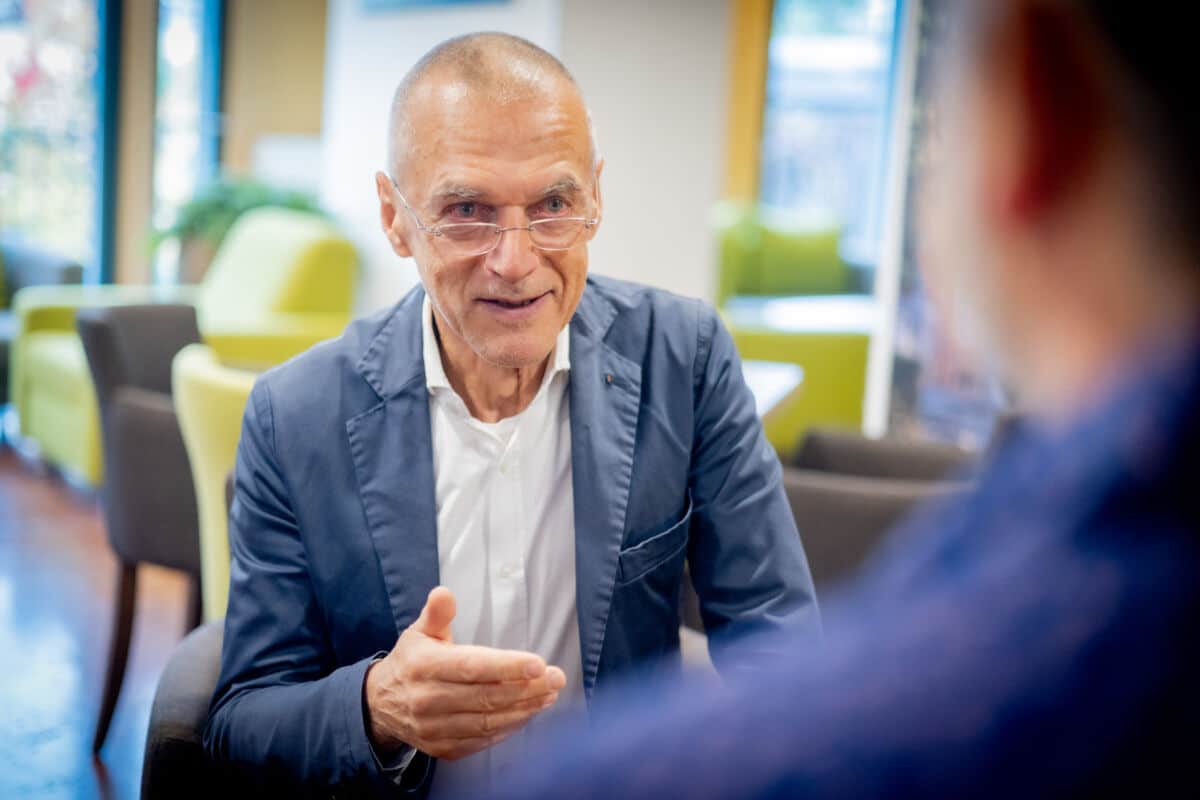
The underestimated power of the voice
Every voice tells a story – whether you like it or not. It is a mirror of your inner attitude and reveals how you feel in a matter of seconds. Stress, self-doubt or stage fright not only limit your thoughts, they also change the sound of your voice. It sounds pressed, monotonous or even dismissive.
But the good news: You can consciously influence the sound of your voice. The key to this is your inner attitude, which depends directly on your preparation and your emotional attitude.
How much this change works is shown by an example from my everyday coaching life.
A practical example: From strict charisma to convincing resonance
An experienced manager was faced with an enormous challenge: As part of a change process, she was to restructure the logistics of a large company. Resistance in the team was inevitable. When preparing for the decisive stand-up meeting, the manager's focus was fully on the content to be presented. The consequence? His aura was stern, almost sinister. Without realizing it, he sent out messages that only strengthened resistance.
In coaching, we changed the approach. Instead of just perfecting the content, the manager concentrated on his own attitude. He learned to look forward to the opportunities of dialogue and to visualize the possible positive reactions of his team. This change worked wonders: his voice became warmer, more inviting and more resonant. The result? The team reacted openly, showed understanding and gave him positive feedback – and this in a situation that previously seemed almost hopeless.
Why anticipation makes the difference
What is the secret of this transformation? It starts with the inner attitude.
The 4 core messages of the voice
One of the key messages I have found in my Stimmcoaching is: Your voice is always an expression of your physical and emotional state. If you are tense, stressed or nervous, this is shown by:
- Pressed timbre
- Monotone or tense pitch
- One-dimensional modulation
Conversely, anticipation and confidence create a completely different effect. Your body becomes looser, your muscle tone more harmonious. The voice sounds more resonant and approachable – an effect that is unconsciously picked up by the mirror neurons of your conversation partners. These automatically react more positively and reduce defensive attitudes.

Practical Tips: How to Prepare Your Voice and Message
1. Focus on the positive: Activate the outward drive
Most of us prepare for meetings or presentations by gathering facts and arguments. But that alone is not enough to reach your audience – and certainly not to convince them. Your first step should be to focus on the positive aspects of the message in order to activate the drive of your listeners.
Ask yourself the following questions:
- What concrete advantages does your message offer?
(e.g. "Where exactly does this reduce the Change labor costs? Where could our efficiency increase?") - How do the audience benefit directly from the implementation?
(e.g. "If you think about the team's day-to-day work – where exactly are relief noticeable as a result of the new structures?") - What are the long-term improvements for the team or organization?
(e.g. "If our position in the market was clearly under pressure this year – where in your area will the new system make us fit for the future and strengthen us?")
But this is often the crux of the matter: only addressing the benefits often seem abstract and rational – this rarely reaches the level where change actually takes place. This is where the way-from drive comes into play.
2. The underestimated key: Targeting drifters
People often react more strongly to the desire to avoid unpleasant things than to the prospect of profit. You can activate this "path-from-drive" in a targeted manner by gently pointing out possible negative consequences that could occur if no change takes place. This requires tact: no one likes to be manipulated by threats or fear-mongering. Instead, you can focus on everyday scenarios, on well-known annoying or urgent aspects. It is best to use a highly effective form of suggestion that immediately activates the imagination:
- Name latent challenges:
„Wenn Du gestern gerade erlebt hast, wie schnell die unklaren Abläufe zu Fehlern in der Produktion führen …” – … [hier eine der oben skizzierten “Hin zu”-orientierten. Fragen anschließen!]
- Illustrating the pain of the status quo:
- „Gerade gestern hast Du mir gegenüber vom Frust gesprochen, den die ständigen Abstimmungsprobleme erzeugen …” – … [hier eine der oben skizzierten “Hin zu”-orientierten. Fragen anschließen!]
- Demonstrating the risk of stagnation:
„Angenommen, wir machen so weiter wie bisher, und Du schaust dann am Ende des nächsten Quartals auf den Vergleich mit dem Mitbewerb …” – … [hier eine der oben skizzierten “Hin zu”-orientierten. Fragen anschließen!]
It is important not to formulate these "away from" messages in an alarming way, but as an invitation to action. Your goal is to make the urgency clear without spreading panic.
3. Promote a change in perspective through social drivers
While rational benefits such as cost savings and increased efficiency are often discussed, it is usually social motivations that really make people rethink. The listeners must get the feeling that the change also strengthens their personal position and standing within the group.
- Emphasizing community and belonging:
"With these changes, we are creating a team that works more closely together and finds solutions faster. Each of you has an important role to play in this process." - Promote self-efficacy:
"Your expertise is crucial to successfully implement these new structures. Without you, this process cannot work." - Expressing appreciation and recognition:
"I know that change is often challenging. But I see how committed and solution-oriented you are – that's why we're going to do it together."
Such messages speak to people's deep-rooted needs for recognition and belonging. They reinforce the desire to be part of a positive development.

4. Use voice and body language in a targeted manner
Now that you've tuned your messages to to-to-and away-from-drives, you need to make sure that your voice and body language reinforce those messages.
- Tone and modulation:
A warm, approachable voice, which varies between deep resonance and lively emphasis, signals confidence and invites cooperation. - Posture:
An open, approachable posture (upright posture, relaxed shoulders, eye contact) underlines your willingness to seek dialogue. - Use pauses in speech in a targeted manner:
Use pauses to let important statements sink in and give the audience space to think. - Slow and clear pronunciation:
Especially in controversial meetings, it helps to convey calm and control through a conscious way of speaking.
Why this combination is so powerful
If you address both towards and away-from-motives and focus on social drivers, you create an atmosphere in which change is not perceived as a threat, but as an opportunity. Combined with a resonant, warm voice and open body language, you set the framework for real openness and dialogue.
In the case described above from my coaching practice, it was exactly this mixture that made the difference: The manager clearly presented the advantages of the change process, addressed the fears of his listeners empathically and conveyed the confidence through voice and attitude that this path would be successful.
These detailed additions make the blog post even more practical and inspire the reader to apply the principles shown directly in everyday life. Does that suit you?
The voice-espresso dialogue: 15 minutes that make the difference
Sometimes it only takes a small impulse to initiate big changes. In a 15-minute voice-espresso dialogue, we will analyze together how you can bring more lightness and persuasiveness to your conversations through conscious use of your voice. We develop concrete strategies that provide you with immediately noticeable results.
Do you want to find out how much potential there is in your voice?
Then discover how anticipation makes your voice the key to success – and secure your appointment now!
Conclusion: Your voice, your success
Anticipation isn't just a nice feeling – it's a powerful tool that you can use specifically to make conversations and meetings positive. If you learn to change your inner attitude, you will experience how your body, your voice and ultimately your counterpart change.
It starts with a simple question: How do you want to sound the next time you enter the room?
I look forward to accompanying you on your journey. Talk to me about your challenges over an espresso ☕.

Your Arno Fischbacher
Maybe also interesting:
-
How to get your stage fright under control – Part 1
-
How to get yourself "under control" again at any time with Sense Focusing
-
3 tips – how to avoid nervousness in the voice
The author:
Arno Fischbacher is a business voice coach and rhetoric expert, speaker and author. He prepares executives and employees of the top companies in Germany and Austria for negotiations, presentations and media appearances. Fischbacher is the author of several books, past president of the German Speakers Association (GSA) Austria, chairman of the European Network of Voice Experts, stimme.at.
If you want to learn more about specific training opportunities with me, please make an appointment here free information talk.


Leave A Comment