

Become self-confident! – Three tips
Appearing self-confident and representing one's own point of view confidently and confidently is more important today than ever before. Because how often do those who proclaim half-baked ideas and crude points of view with superficial volume prevail at work, in private life, but also in public. Meanwhile, clever thoughts, important ideas and less coarse opinions go unheard because the right words are missing at the decisive moment or the well-meaning voice is drowned out.
In this article, you will read how to become self-confident through confident language and a powerful voice and thus help your ideas and views to achieve a breakthrough.
Her voice coach remembers ...
"Why didn't the theatre newspaper go to the post office yesterday as planned?" With an angry face, the director suddenly stands in my small office.
Moment of shock. Thoughts shoot through my head: "Why is she asking me of all people? It's really not all my job!"
Uncertain and somewhat gruff, I answer: "Uh... that didn't work out yesterday because the driver was on the road with the costumes!"
The director gives me a scathing look and leaves the room without a word. I am left uncertain, annoyed that I could not clearly express that everything has already been set in motion anyway so that the brochures reach the addressees in time. That the accusation made me so insecure. That I had stood there like a watered poodle. That I almost stammered and my voice sounded so meek.

Uncertainty remains in the memory
This incident from my first years as an organizer in the former Kellertheater in Salzburg went through my head when I first thought about this blog post. The struggle with my self-doubt and my inner insecurity has occupied me for many years.
Precisely because I myself have failed at this topic for so long, this motivates me today to show my participants and coachees simple and highly effective strategies on how to become self-confident and inspire your clients with sovereign Convincing language and powerful voice .
Why uncertainty has a twofold effect
First, let's take a look at the multiple effects of insecure appearance.
A lack of self-confidence has a negative influence on communication:
- Lack of credibility: Unsafe body language and voice unconsciously question what you are saying. Your expression then denies your statement, they seem incongruent.
- Lack of problem-solving competence: Uncertainty in expression easily tempts your interlocutors and listeners to doubt your assertiveness. Their ability to solve problems is questioned.
- Conflicts: Justifications born of uncertainty or slapdash answers often trigger unnecessary conflicts.
Uncertainty has an equally disturbing effect internally:
- Conflict prevention: The frequent experience of one's own insecurity in delicate situations quickly leads to avoiding such occasions.
- Self-doubt: As long as one's own insecure behavior provokes the above-mentioned reactions of the outside world, this reduces one's self-esteem in the long run. A vicious circle has emerged.
- Dissatisfaction with oneself: Uncertain reactions often have a long lasting effect on the inside. Thoughts like "Why did I react so insecurely again?" gnaw at self-esteem.

What makes self-confident appearance and confident language so important today?
Who takes the time for an in-depth conversation today to explore the hidden qualities of their counterpart in detail? In fast-moving times, first impressions are of particular importance. Studies show that the first five seconds of a phone call dramatically influence the further course of the call. The same applies to the first words of your presentation, your request to speak in the meeting, etc.
Why knowledge alone does not help
Perhaps you are now also saying that this is nothing new so far. Most of the people I work with in workshops or coaching are also aware of these effects. But why do so many people fall into these traps every day?
-
We react and act "autopilot"-controlled:
How you react to others in everyday life, what answers you give, what feelings you act out of is largely automated. External stimuli recall practiced patterns of action. Maybe you know those moments when you would like to bite your tongue because you had just said exactly what you wanted to avoid?
-
Voice and language have a largely unconscious effect:
However, this does not only apply to our effect on others. Our own effect is also largely hidden from us. This is a fatal cause of recurring communication problems. Since we perceive our automated patterns of action, i.e. the behavioral "grooves" we have practiced for years, as quite normal (and therefore also "correct"), it makes sense to blame others for communication problems.
-
Uncertainty is audible:
The voice as a sonorous expression of body language reacts to every slightest inner movement. The telltale uncertain voice sound is caused by those three muscle zones in the body that are also responsible for body language: The shoulders are pulled up slightly, the neck is tense. This significantly narrows the radius of the gestures and causes monotonous speech. The voice sounds less expressive, gets higher and tighter.
A lack of confidence is also expressed in the face, here it is especially the masticatory muscle that tenses and often makes the voice sound pressed. Especially when the situation is already emotionally charged, the stomach and the muscles in the abdomen like to react. Apart from the strong feelings that are triggered by this, this tenses the respiratory muscles excessively, the upper body protrudes a little and voice and body language lose space and effect.
Three practical tips: How to become self-confident through confident language and powerful voice
Perhaps you also feel that working on self-confidence is a lengthy process and that progress is difficult to see? Today I offer you a selected handful of practical tips that are not only immediately effective, but also give you the prospect of many unexpected successes.
Follow the success steps in project management when implementing it:
- Describe the current state, set achievable success goals
- Plan small, achievable steps
- Check results and celebrate successes
Go through your everyday life in your mind and note:
- Which moments clearly call for more self-confidence and sovereignty?
- What bothers you most about your own reactions and behavior patterns?
- How exactly is this expressed in body language, voice and language?
Success tip 1: Become self-confident step by step with "Power Posing"
Most people take a scrutinizing look in the mirror before leaving the house. And in doing so, they use the best-known way to experience themselves: visual "self-representation". With my tips, you can use the other two channels of self-experience today, which remain completely unconscious for most people:
- Increase self-confidence through self-confident postures (kinesthetic self-representation)
- Strengthen your own security through self-confident, powerful sound of the voice (acoustic self-representation)
You may be familiar with the well-known TED Talk by the American psychologist Amy Cuddy zum Thema „Power Posing“ . In it, she shows in a very entertaining and impressive way how and by what means certain postures have such a strong influence on one's own emotional world. Here's how to use this effect in practice:
-
The "coachman's seat":
Detach yourself from the backrest and move forward so that you can sit at about the front third of your chair. Make contact with the ground with both feet. Intentionally make yourself big, as if you wanted to slip into the role of an overconfident person. Notice how you have now grown a little taller and your neck has straightened and tightened slightly. Did your shoulders just let go? Good job! Do you feel yourself feeling more powerful and secure now? Wonderful. Save this feeling and sensation.
Attention: Maybe an inner voice is coming up and warns: "That's exaggerated! Don't make yourself so big, so important!" Every conscious change in behavioral patterns meets with inner resistance. Therefore, incorporate the exercise into your everyday life for a few seconds every now and then. Learn: Self-confidence can be activated at any time by small changes in posture! -
Your visible "point of view":
Do you want to emphasize your statements while standing? Just imagine that the ground is in motion – for example, because you are standing on a bus or train. Do you notice how this changes your posture? Your center of gravity shifts noticeably forward, your knees are no longer fully extended, you feel this dynamic force in the middle of your body. again you have become a little taller because your neck has straightened and tightened. If you now feel inside yourself, perhaps you also experience yourself much more stable, grounded, in balance inside. Cheat this exercise into your everyday life and pay attention to the effects, both internally and externally!

Success tip 2: Gradually become self-confident with a powerful voice
Perhaps you also think of your listeners and interlocutors first when talking about the effect of the voice. Be aware today of the extent to which the tone of your own voice affects you and your sense of self. Develop your vocal awareness!
Buzz Amplifier:
- They intonate a relaxed, long-drawn-out buzzing tone: "mmmm...". It is best to close your eyes, this will make your perception more precise. Pay attention to how this tone sounds (acoustic self-perception) and feel exactly where you can perceive the vibrations of your vocal tone (kinesthetic perception).
- Now slowly change your posture while humming. Use the instructions from earlier. If you are sitting straight, you will switch to the coachman's seat in slow motion, humming in slow motion. To prepare for a powerful voice for standing conversations or presentations, humming slowly switch from your casual stance to the conscious point of view.
We talked about the success steps in the project above, now it's time to evaluate and control the change. How has your voice changed? What did you hear and feel differently? Try to describe the results, as small as you may seem at first, as accurately as possible.
Praxistransfer:
- Do you want to quickly enjoy your changed effect and surprise those around you with a powerful voice? Incorporate these one-second exercises into your everyday life unnoticed!
Success tip 3: Get out of the justification trap!
Remaining self-confident in delicate situations often fails due to the unconscious power of everyday mechanisms in communication. They force us to react thoughtlessly at the moment, which we regret later.
You will probably experience one of these mechanisms several times a day, which gives you many opportunities for practice for the following tips. I am talking about the involuntary reactions to accusations or Objections . Because they lead far too often to justification or counter-argument.
The trigger of this unconscious and powerful mechanism is the combined leadership of reproach (or objection) and frontal body position.
Do you remember my rather clumsy linguistic reaction to the director's accusation at the beginning of this article? I had fallen into the trap of justification!
-
Accusation creates confrontation:
The accusation hit me head-on, which forced me – without noticing it – to turn head-on in the direction of my interlocutor. When people face each other head-on, emotions and physical states are transmitted particularly quickly (influenced by mirror neurons).
-
Accusation causes relationship disorder:
Since the accusation is directed head-on at the person, it is interpreted – without considering it – as an apportionment of blame. This ball is now usually played back quickly, who wants to let the accusation sit on them. For most people, the best-trained autopilot reaction for this is justification.
Use the alliance for more security and self-confidence
Maybe you know this unpleasant feeling in the narrow elevator when someone is directly opposite you head-on? I am sure that in such moments you use a core element of spatial psychology and turn a little to the side. The urgent feeling has already given way.
Pleasantly, there are only two basic patterns of spatial relationship between two individuals:
- Frontal: The effect is either confrontational, if there is a disagreement; or clarifying when you delegate something or express your point of view.
- Solidarity: So you relate to something third together, you form a triangle between relationship and thing.
And this is how you can practically use the closing of ranks:
- Trigger: Recognize the situation! Which recurring patterns alert you clearly enough?
- Switch internally: Feel the power of the mirror neurons, which wants to move you to the usual defensive reaction. Switch to active listening! Notice the accusatory tone, record a word or two. Acknowledge what you hear with an attentive listening sound: "mmhm?!" Do you notice how this reduces your own body tension and lets go of your shoulders?
- Solidarity: Turn slightly sideways. Take the initiative with your hand the topic that was just between you and disturbed your relationship, and clearly give the topic a new place ... form the solution triangle of yourself, your conversation partner and the topic.
- Rhetorical echo: Instead of an answer or a justification, you first restore the relationship. Repeat one aspect of the accusation questioningly. In my example from the beginning, the accusation was: "Why didn't the theater newspaper go to the post office yesterday as planned?" A possible echo would be, for example, with a questioning look: "mmhm?! … The shipping, yesterday? … mmhm?!" Make sure that you take the other person's concerns audibly seriously and invite them to speak along.
- Recognizing the need behind the accusation: As a rule, you now hear the personal concern behind the accusation, the big "Because ...". You now allow your interlocutor to explain his or her anger. The problem you are both now looking at (triangle = hand) becomes clear and clear to both of you.
- Open view of the solution: As soon as you hear that the voice of your conversation partner sounds unrelated and less annoying again, it's time for your solution offer or your question for the solution.
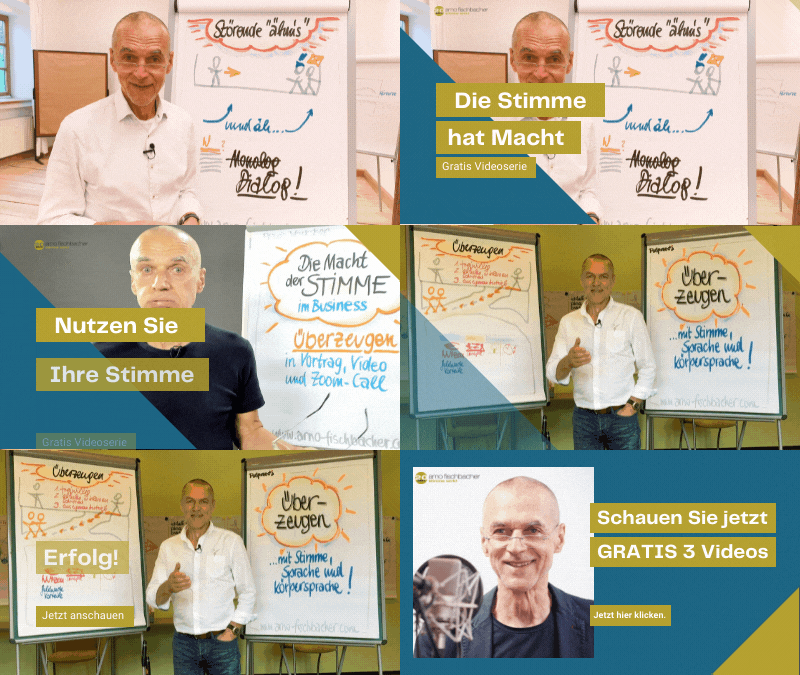
Always appear self-confident with a powerful voice and sovereign language?
New patterns of behavior need to be trained. In order to appear "automatically" self-confident later on, practice today in short, innocuous everyday moments. In this way, you will learn in a brain-friendly way and experience your deserved success in the shortest possible time!
-
Power Posing:
Train to strengthen the inner To overcome resistance to the feeling of power , which is created by the coachman's seat, or the full upright position while standing. Learn to enjoy your self-confident effect!
Power of the voice: Bring the sound of your Stime back into your consciousness again and again! For a few seconds over and over again, enjoy how your voice gains volume and power as you straighten up as you hum. Later, start important statements from this status and rejoice in their effectiveness!
-
React linguistically confidently:
Pay attention to the many confrontational moments in everyday life! Resist the automatic reaction from time to time, close ranks and take the lead in the conversation for this moment. Enjoy the feeling of sovereignty and celebrate these small important successes!
Do you remember my anecdote from my time at the Salzburg Theatre a long time ago? Today, I often ask myself thoughtfully how different my management career at that time would have been with my current level of knowledge and experience. As an actor on stage, I already knew how to use voice and language powerfully back then. At that time, I was faced with the challenge, as perhaps you are right now: to apply the new knowledge in practice and appear self-confident with a powerful voice and sovereign language!
 Yours sincerely,
Arno Fischbacher
P.S.: I'm happy if you like this post. If so, please share it on one of your networks! Do you have a question or would you like to discuss my thoughts with me? Write a comment! I look forward to hearing your opinion!
Read Also:
Arno Fischbacher is a business voice coach and rhetoric expert, speaker and author. He prepares executives and employees of the top companies in Germany and Austria for negotiations, presentations and media appearances. Fischbacher is the author of several books, past president of the German Speakers Association (GSA) Austria, chairman of the European Network of Voice Experts, stimme.at.
If you would like to learn more about specific training opportunities with Arno Fischbacher, make an appointment here free information talk.
Terrific! Thank you very much. This week, experienced similar (reproach situation) and did well!
All the best, Helga Herzog
These are always particularly tricky moments, aren't they? Congratulation!
Thank you very much for your very well described exercises, which I know as a voice coach of course....but always put it differently, asking you to think about it again.
And the thing with closing ranks, I'll practice that soon....a great transfer into direct communication, and its pitfalls – thank you:))
Hello Ms. Dohmen, thank you for your nice feedback! And as far as closing ranks is concerned, the topics of spatial psychology seem to me to be generally undervalued and nowhere reasonably broken down. In my last blog post about small talk, I described the topic in more detail, maybe this is interesting for you: https://arno-fischbacher.com/kann-man-smalltalk-lernen-klar-mit-diesen-drei-schritten/ … Looking forward to your thoughts on this! Kind regards, Arno Fischbacher