

By guest author Michael Kuehl-Lenjer
"For me, there is only one quality that takes me further, and that is curiosity."
Daniel Barenboim (born 1942), Argentine-Israeli pianist and conductor
All people are born curious. Children explore their environment, are eager to learn and inquisitive, and hungry for new things. Children are passionate about playing. They repeat what is known, imitate it and invent something new. Children are equally fascinated by familiar and unusual things. One is well-known and safe and provides security and support. The other, the unknown new, satisfies the irrepressible desire for knowledge. We don't have to motivate children to discover or play. Playing, like all creative activities, is "intrinsic pleasure, pure pleasure" (Sacks 2017).

Curiosity is deeply rooted in our lives from a phylogenetic point of view. The desire to get to know something new has always been the driving force for extraordinary achievements and is a special prerequisite for intellectual creativity. Curiosity is a thirst for knowledge coupled with the willingness to discover new things, to consciously expose oneself to unfamiliar situations and to steer one's way of thinking in a different direction. Curiosity is the basic prerequisite for discoveries.
Curious people are not snoopers who rummage in the dark corners of their fellow human beings, but people who like to tinker, are thirsty for knowledge and leave well-trodden paths of thought.
There is creative potential in each of us
Anyone who is actively looking for a solution is curious. That's why tutorials are so popular, not because they impart knowledge, but because you're looking for the solution to a problem. You create curiosity by withholding information and creating a secret. In marketing, one of the most important basic principles is to withhold information: The next big thing is coming in September! Be curious!
There is creative potential in each of us. A large portion of curiosity is the precursor to creativity. Nowadays, everyone wants to be creative. Many even have to, because specialist knowledge is not enough to survive in the profession. Therefore, many companies expect applicants to also bring ingenuity, creativity and creative spirit to the table.
Creativity at the touch of a button? There isn't. A rule of thumb for flashes of inspiration? Doesn't exist. The ideal way to get more creative ideas? Nobody knows that.
However, we have experienced that in phases of rushed, routine and efficiency-driven work, new ideas do not necessarily sprout. We need leisure and daydreams to come up with new flashes of inspiration. Our brain's resting network is a state of high creativity. Daydreams facilitate creative associations and support us in developing original ideas. When I ask in my seminars when the best ideas bubble up, many answer: while showering, jogging and when we are daydreaming. A good spiritual idea is when it represents a solution or changes something!
Pressure and stress kill creativity
Imagine you are sitting relaxed at your desk or on the couch and are supposed to find something completely new on a topic within three minutes. That won't work, because it's completely impossible to create something new under time pressure. Creativity does not arise in ready-to-go-mode. Under pressure, our store of ideas does not seem to be able to reveal its treasures. Stress often gets in the way of creativity, we feel pressured. Federico Fellini said: "Creativity is intelligence that has fun." And stress and pressure are no fun. The amygdala (danger smeller) kicks in with negative emotions, the body's stress system is switched on and ensures that vast amounts of cortisol enter the bloodstream. This hormone signals: "Attention, danger is imminent!" and puts the organism in a state of fight or flight. It is not surprising that the creative spark does not ignite in this situation. Conversely, creativity is throttled if we are supposed to develop flashes of inspiration for about thirty minutes. No flow of ideas lasts that long.
The mental ruminant in us hinders mental openness
Of course, we can't be creative all the time. In order to cope with our everyday life, we fall back on routine, habits and learned processes. This saves a lot of energy. When we are stressed, we act as mental ruminants, we roll over the same thoughts over and over again and find it difficult to adjust to something new.
If you can't think of any suitable flashes of inspiration, there is no point in forcing a solution. Work on another task or take a walk in the park during your lunch break. To get mental creativity going, sporting activities could also be suitable. Studies have shown that running boosts our creativity. Do it as Theodor Fontane wrote: "Peace, silence, sofa and a cup of tea are more important than anything."
Flashes of inspiration and bubbling ideas are the most important factor for economic Success – at least that, according to the result of an IBM study, is the assessment of one thousand five hundred company bosses from sixty countries. Companies that are not innovative gamble away their future. Creative achievements and brilliant ideas are shown in particular by those people who look back on a comprehensive, even contradictory wealth of experience and are therefore focused on alternatives in overcoming challenges.
Creativity, i.e. the ability to solve problems through creative approaches, is inherent in every brain. Our personality is the result of genetic predisposition, prenatal and early childhood imprint and the sum of our experiences and experiences. There is no evidence of genetic dispositions to creativity.

Breaking with thought patterns
"The ability to come up with new ideas [...], is a question of attitude and whether you encourage people to actively question things. Unfortunately, we often do the opposite today. We demand that people think flawlessly and accurately, and underestimate that creativity is always based on breaking with thought patterns or combining thought patterns in an unusual way. It's inconvenient, but it's the only way to come up with really good ideas. Convergent thinking meets the basic human need for control, order and orientation, but also promotes black-and-white thinking. Breaking with patterns is a great way to find new ideas. Pattern breakers are by no means against everything, as they are accused of in some companies. People come into the world without having a single pattern in their heads. That's why people can grow up almost anywhere. After many years of life, however, the skull is filled with countless patterns.
Neurobiologist Gerald Hüther defines creativity as the ability to suddenly find solutions in the existing pool of knowledge on how things connect in ways that were previously thought impossible. For this to succeed, it is necessary to let the brain run free. The desire to create something new can only develop if it is not restricted by standards and guidelines. The former Prime Minister of North Rhine-Westphalia, Jürgen Rüttgers, once said: "Bill Gates would have failed in Germany simply because according to the building use regulations, there may be no windows in a garage." (gutezitate.com)
The opinion that creativity is or is not is wrong. Creativity can be learned. Promoting the curiosity and creativity of employees is a leadership quality that lays a trend-setting foundation for a successful future.
Curiosity and thirst for knowledge activate the reward center
The US neuroscientist Kirk R. Daffner took an unusual test in the 1990s. He showed a group of pensioners strange drawings of animals. Some were curious about what the structures were supposed to represent, others were not interested. As the study leader noted, those who were indifferent had dementia. It should come as no surprise that dementia patients have a lower Attention to the world. "But could the connection also be true the other way around?" asked the scientist. "Could it be that it was not simply the disease that made the patients indifferent, but rather that they became demented because they lost their curiosity at some point in their lives – many years before the onset of the brain disease?" (GEO kompakt 2015)
If we want to know something, the reward center in the brain is activated. And when we have learned something new, we are rewarded with a feeling of happiness. This, in turn, keeps you young! Bubbling creativity and ingenious ideas do not arise in a mastermind, but are the result of a brain-friendly basic attitude open to new things, including a good portion of curiosity.
What can we do?
#1 Not creative?
Forget it! Compare yourself to yourself instead of others! Look at your own learning curves. Do small exercises: Cook yourself a meal with ingredients you have put together. Is an ingredient missing? Then think about an alternative! You want a Presentation demonstrate? The technology does not play along. Think about how you can present your core messages differently present can.
#2 Overcoming thought patterns
Review entrenched thought patterns and consciously work against them. In which situations do you react "automatically" again and again, which actions no longer fit into the times?
#3 Question if-then rules?
When something specific happens, I always react in the same way. Question these reactions and change them when it seems reasonable.
#4 Creativity needs rest
Don't try to try something new or be creative under pressure in hectic moments and sometimes "in between".
#5 Stay curious and show serious interest in your interlocutor!
Ask people around you what they do. Express interest in the person. Refrain from giving the impression that you are a snooper, avoid closed questions. Maintain eye contact.
#6 Flashes of inspiration just happen
Flashes of inspiration cannot be forced, the brain needs the resting network for this. Activate your quiet network by doing nothing, daydreaming, and letting your mind fly.
The author:
Michael Kühl-Lenjer combines many years of sales, management and training experience with the latest findings in brain research. As a business trainer and communications consultant, he supports companies and training institutes in incorporating neuroscientific aspects into their education and training. Michael Kühl-Lenjer is a member of the Academy for Neuroscientific Educational Management (AFNB) and obtains his neurobiological knowledge directly from scientists. » https://www.kuehl-lenjer-training.de
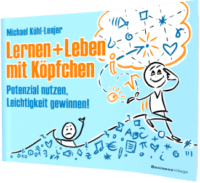
The new book by Michael Kühl-Lenjer, “Leben und Lernen mit Köpfchen. Potenzial nutzen, Leichtigkeit gewinnen! Eine Gebrauchsanleitung fürs Gehirn.”has been published at BusinessVillage 2024. Here at » View Amazon.
Also read on this topic:
Leave A Comment