

3 practical tips on how to work better with voice coaching
A customer had asked me for feedback on his new video. So I sat there and followed the very elaborate and professionally made video message. My customer – to maintain anonymity I'll call him Günther here – has what it takes and successfully goes his way. He is also a very dynamic character. In this video, he explained the benefits of his offer, his methodology and expressed himself in chosen words, there were professional text inserts and a good dramaturgy in terms of content. And yet, the longer I watched, the more I wondered.
Namely, about where the charism, the great charisma that I otherwise know from this person had remained. They didn't come across at all. Günther seemed impersonal, slightly automated, almost robotic and completely devoid of empathy, otherwise one of his most urgent character traits. His proverbial approachability, which I myself appreciate so much about him, was as if wiped away ... In the more detailed analysis of this Stimmcoaching I quickly realized why that was.
Working on the language: This is also voice coaching
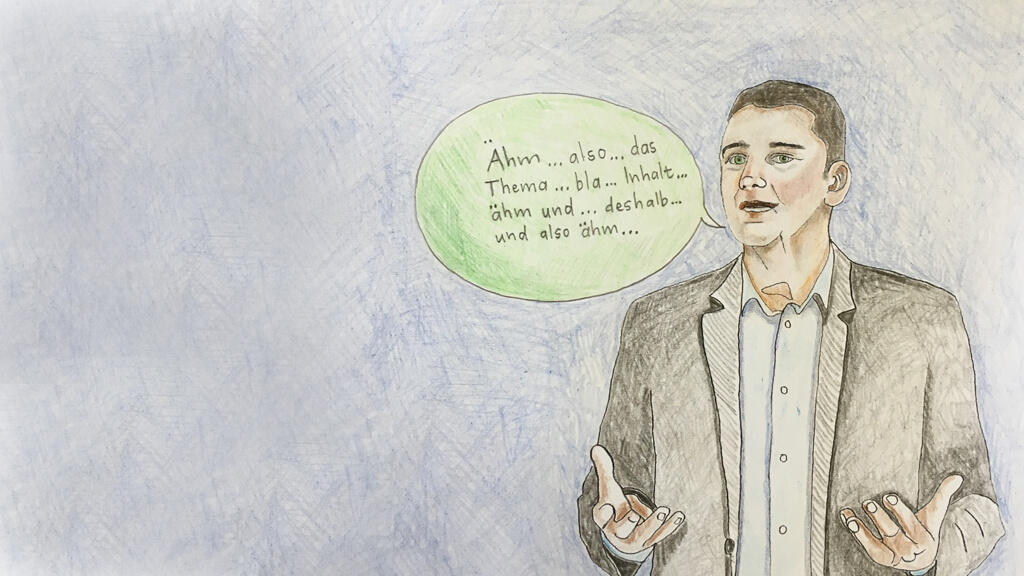
When I coach people, we usually do not do voice exercises, but also devote ourselves to many other components that have an influence on the voice and, above all, on the effect. As in this Stimmcoaching to the video. Why did Günther seem so de-personalized and stiff? The answer is basically simple: He had prepared his text too intensively and learned it almost by heart to speak fluently and without "ums" in the video. This is laudable, but leads to the fact that the performance usually lacks any spontaneity and lightness.
- The speaker seems "unassailable", rigid and not attractive to people.
- There are no pauses in speech.
- One set of garlands pulls the next with it.
The result: The viewers have the feeling that someone is reading a specialist article here. Memorized or read. Both are equally bad in terms of effect. Even people with high communication skills cannot live them out in a lively way. In this way, Günther has also not succeeded in transporting what makes him who he is, his true personality and essence. In short, his video failed in terms of building a relationship level.
Voice and speech patterns shape relationship
To understand why this is so, let's see how successful dialogue works. One says something, the other person answers or reacts. By nodding, affirming or even making a statement. The conversation develops on a reactive basis, one reacts to each other's impulses. And that's exactly what is missing in the video, in which only one speaks and there is no dialogue. What is said seems "as it was said", without depth and resonance, because at the moment of the recording there is no one there who is actually listening with interest. This leads to this peculiar perception of statics and aloofness in Günther's video.
My voice coaching recommends the "chain of questions"
What is the solution? My recommendation as a coach is to use speech patterns. In voice coaching, I recommended to Günther to build up a chain of questions within the structure of the presentation for the re-recording of the video, which would enable him to turn away from himself and towards his audience.
- So Günther asked the imaginary audience a question and answered it himself – after an appropriate pause for tension.
- This creates a "silent" dialogue, which the future audience of the video perceives as very lively.
This approach immediately loosens up the monotony of the method chosen in the original video immensely! The chain of questions is also the perfect stylistic device to loosen up presentations in front of an audience and not to make them seem like a lecture!

However, anyone who works with the chain of questions in this way must not fall into the trap of exaggerating and firing off a veritable volley of questions to his audience. This immediately creates an interrogation character and repels the listeners. Rather, it is a matter of finding the perfect balance between knowledge transmission and cleverly placed questions.
Until then, take good care of your voice!
 You
You
Arno Fischbacher
P.S.: I'm happy if you like this post. If so, please share it on one of your networks! Do you have a question or would you like to discuss my thoughts with me? Write a comment! I look forward to hearing your opinion!
You can read here how to avoid annoying garland sets:
The author:
Arno Fischbacher is a business voice coach and rhetoric expert, speaker and author. He prepares executives and employees of the top companies in Germany and Austria for negotiations, presentations and media appearances. Fischbacher is the author of several books, past president of the German Speakers Association (GSA) Austria, chairman of the European Network of Voice Experts, stimme.at.
If you would like to learn more about specific training opportunities with Arno Fischbacher, make an appointment here free information talk.
Leave A Comment