

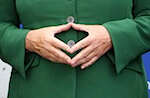
 Where to put your hands when presenting? This is probably one of the most frequently heard questions when it comes to an effective appearance. Somehow they get in the way as soon as you stand in front of people and speak. They hang awkwardly on shoulders and elbows. Disturbing somehow. So where to put it?
Jetzt beginnt das Problem. Denn besonders schlaue Zeitgenossen haben irgendwann die Mär in die Welt gebracht, die Zone unterhalb der Gürtellinie sei “pfui”. Also nur nicht mit den Händen dort herumwedeln, das verbreite schlechten Eindruck, heisst es.
Wohin aber sonst damit? Wo ist der Zaubertrick, der meine Hände einfach verschwinden lässt, sobald ich aufstehe, um nach vor zu gehen? Einfach vor den Oberkörper halten, heißt es dann. Ellbogen anwinkeln, Hände offen vor Brust oder Bauch. Und wenn das auch so ein komisches Gefühl entstehen lässt, die Hände ineinanderlegen. Offen natürlich, und locker. Oder gleich die “Merkel-Haltung” nutzen, Fingerspitzen aufeinander gepresst, als wollten Sie den Allmächtigen anrufen.
What is the result? Surely you know the result of such well-intentioned, but unfortunately fundamentally wrong advice. The effect is fatal. Because gestures that are used all too consciously are always perceived as spurious. As not authentic. As trained. And not at all sovereign.
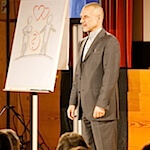 Therefore, my urgent recommendation: Refrain from this false aid. Their gestures unfold all by themselves, if the conditions for them are met. tune . If you have found your point of view in the room – understood quite literally. Two feet on the ground, well grounded: There I stand, I have something to say. Before your first word, allow yourself this second of inner concentration. This is how attention is created. And you will notice that your shoulders let go, your arms just sink loosely down. Wonderful. Now you radiate security. It's obvious – you have something to say.
And then the magic happens. The first word sets the gestures in motion. When you impulsively address someone, the brain always sets the torso, arms and hands in motion first, only then does the tone of the voice follow. Just observe this in everyday life.
So where to put your hands when presenting? Look for a point of view, pause for a second and collect yourself, feel that your shoulders let go, then get started. And your hands do what they can't help doing – gesticulating. Informal, authentic, natural.
Merkel's attitude... reminds me of the belly dance exercises... when exhaling, close the muscle inwards and pull it up to your belly button... Maybe she's practicing secretly or she wants to say. looks at my navel and not at my face
With Mr. Fischbacher, I assume that he is speaking and letting his voice work and thus fascinating his audience... because his attitude rather says... well, then I'll wait and see how my audience reacts!
das ist gut, dumme tipps sammeln!!! :-))
ich finde, brauchbar ist noch die variante, einen stift in die hand zu nehmen, da werden nervöse hände ruhig.
Best regards
Andrea Klein
Jede Regel, wohin die Hände sollen, ist Unsinn, weil alles verkrampft wirkt. Ich empfehlen den Menschen, die bei mir lernen, Veranstaltungen zu moderieren, ein DIN A5-Blatt quer in der Hand zu halten. Ein paar Notizen für ihre An- und Abmoderationen brauchen Sie ja eh. Und siehe da: Das Blatt wird zur “Basis” der Hände – von dort schwirren sie aus und kehren auf magische Weise zurück.
Schade, schade, dass Arno Fischbacher so absolut absolut redet und schreibt….. auch wenn die Idee mit “den dümmsten Tipps” Aufmerksamkeit schafft :-)) Kompliment!!
Denn auch der Tipp: “Höre nicht auf die dümmsten Tipps” kann als ein solcher verstanden werden, wenn es als “Rezept” verstanden wird …
Völlig einig sind wir damit, dass es keine “absolute Wahrheit” dabei gibt und auch vor allem antrainierte Körperhaltungen völlig daneben gehen werden (das allerdings mit großer Sicherheit :-))
Happy work and good luck in trying things out
Dear Mr. Fischbacher,
Your presentation at the WKS gave me good information. Thank you for this beautiful evening.
Kind regards, Rosmarie Weber
Hab mal ein super Poster geshen. Frau Merkel in verschiedenen Situationen, immer die Hände vor dem Bauch mit Fingerspitzen zusammen. Kommentar dazu war: “Superkleber ist KEIN Spielzeug.” Wirkt einfach total unnatürlich.
Dear Mr. Fischbacher,
since I am a singing actor and speech trainer myself, I can only fully agree with you
and thank you for fighting these stupid tips.
Also mein Motto ist eher: “Das Rezept ist: es gibt kein Rezept.” Dumm oder nicht dumm – meist eine Frage der Perspektive, der persönlichen Wahrnehmung und voreiliger Bewertung – oft aus Ignoranz und Unwissenheit, was mich eigene Erahrungen gelehrt haben 😉
Zur “Merkel-Haltung”:
“Sie nutzt eine uralte Energieübung aus der Uckermark. Dazu legt sie beide Hände so zusammen, dass sich die Finger beider Hände berühren. Und zwar so, dass sich Daumen an Daumen, Zeigefinger an Zeigefinger, Mittelfinger an Mittelfinger, Ringfinger an Ringfinger,kleiner Finger an kleinem Finger an den Fingerkuppen treffen.
Skeptisch? Probieren Sie es aus.” Roland Kopp-Wichmann in seinem Persönlickeits-Blog als Tipp für den Umgang mit Ängsten
Dear Ms. Neehoff, thank you for your hint! The beautiful energy exercise you mention can be quite effective, there is no question about that. Before the performance, mind you. However, it seems unsuitable to me during of the lecture or television appearance. And related to this – i.e. to unsuitable tips for appearance and speech – my little blog series wants to be understood.