

Have you ever had the feeling that too much spit collects in your mouth when you speak? And you were afraid of attracting unpleasant attention with too "wet pronunciation"?
Obviously, this topic moves many people, if you believe the search statistics on my website. Surprisingly often in the last year, the question of wet pronunciation was found in it. This shows: If you sometimes have the feeling that your articulation is impaired by too much saliva when speaking - or, on the contrary, you suffer from an unpleasantly dry mouth, then you are not alone!
But it's not just too much saliva that can interfere and irritate when speaking – communication also becomes torture when the mouth becomes dry and the tongue sticks to the roof of the mouth. Both phenomena can be irritating, even really embarrassing at times, especially in important social moments or even during public speeches . Reason enough, then, to dive deeper into the matter in this blog post. Let's find causes and discuss practical solutions!
Something came to my mind while writing, and it was many years ago:
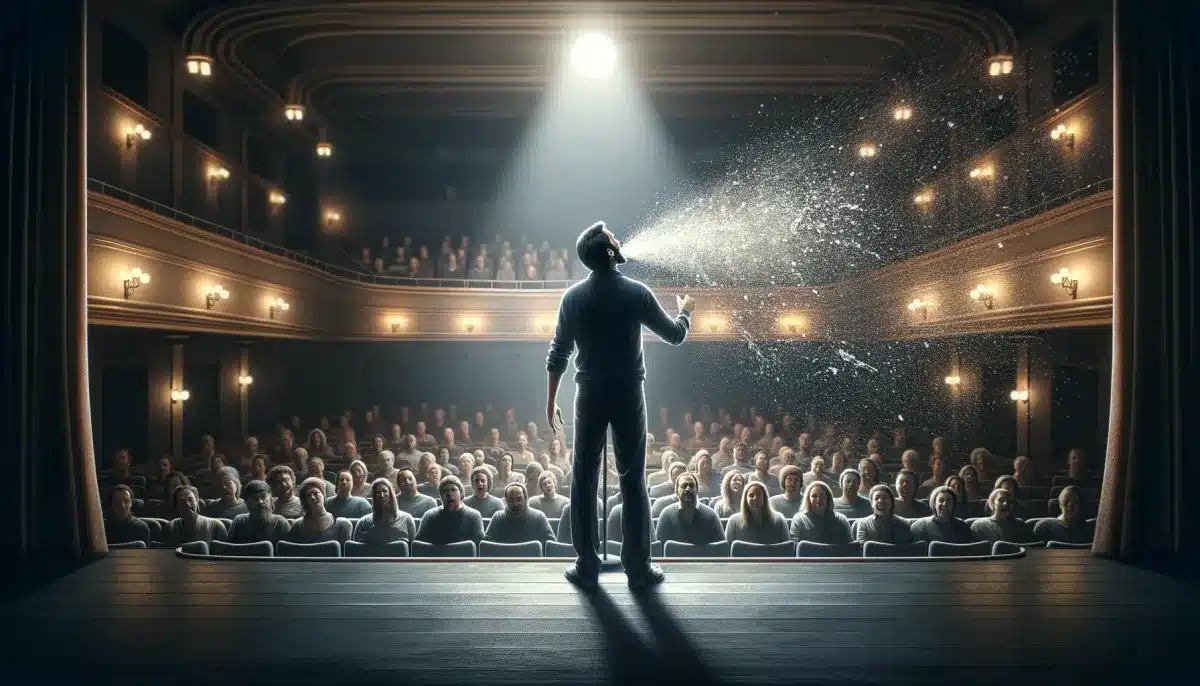
As a young man, I sat in the Landestheater Salzburg, surrounded by the darkness of the room and the tense silence that only the theater has to offer. On stage, Georges Ourth, my long-time mentor, actor and director, shone in one of his countless roles. Georges was not only an artistic genius who directed the stage of the basement theatre where I myself played, but also my greatest role model. I have forgotten the details of the piece, but one scene remains vividly in my memory to this day.
Imagine you're sitting in the front row: the theater is dark, the stage is brightly lit by a single spotlight. Georges stepped to the front of the ramp for his monologue – so close that you could see every expression on his face. And then it happened. As he spoke, the special light drew a fine mist of spray, which rhythmically flowed towards the audience with his words. An audience member in the front row even raised his program booklet as a shield, so visible was the fog of the finest droplets of saliva that accompanied Georges' passionate performance.
Was that already too much of a good thing?
No, and that's why this example is so important to me. Because even then it was clear to me as an actor that the expressive Speaking and building a healthy voice well-moistened mucous membranes in the mouth and throat are an important prerequisite. In that special light, this became particularly clear: the intensity of the Pronunciation , coupled with the brilliance of a trained voice, led to this natural phenomenon. Georges didn't spit excessively—no, he just spoke loudly, clearly, and with a voice that had been almost perfected by years of training. This experience confirmed to me that the Speaking loudly In front of an audience, fine droplets of liquid are always carried away from the mouth, throat and larynx – a natural part of passionate communication that, if you will, visually underlines the essence of the spoken word.
The situation is completely different if the excess of saliva in your mouth even prevents you from speaking up – for fear that it could be unpleasantly noticeable.
Wet pronunciation: More than just a small problem
Anyone who has ever been confronted with this knows that wet pronunciation can be more than just a minor inconvenience. It can actually impair the intelligibility of your words and lead to a. slurred pronunciation. The more you are aware of this, the more you avoid exposing yourself. This can really attack your self-confidence. So let's analyze what's behind it.
One of the main causes of excessively moist pronunciation is hypersecretion of saliva, also known as Hypersalivation . This phenomenon can be triggered by various factors:
- through Psychoneural causes such as severe excitement or pain
- through Swallowing disorders , i.e. if the movement sequences are impaired during swallowing
- during the Pregnancy , in some diseases or as a side effect of some medications
In everyday life, increased salivation is stimulated by
- Strongly spiced or acidic Foodstuff
- by some Beverages , e.g. beer
- that Chewing gum , which can be temporarily helpful if your Mouth dry – but becomes problematic when it is too much of a good thing
Practical tips against excess salivation:
- Pay attention to your diet: Certain foods such as bananas or bread can dampen the flow without negative side effects
- Rinse or gargle mouth with sage tea: Sage has astringent properties and can help reduce the flow of saliva
- Seek professional advice: If the problem is severe and interferes with your everyday life, you should consult an otolaryngologist
As mentioned above, it is not only an excess of saliva that can be stressful. If you can't breathe when you talk, good advice is also expensive.
Dry mouth: A burning issue
Maybe you did this during a Presentation when suddenly the mouth becomes so dry that even speaking is difficult. Why is that? The explanation is quite simple: Whatever your Stress , it is accompanied by tension in the muscles. Three muscle groups are particularly sensitive to stress:
- Shoulder and neck
- Chest and abdomen
- the Masticatory muscles
As soon as the chewing muscles tense, the flow of saliva is throttled, and the spit to talk is suddenly missing.
How to deal with dry mouth during your speech:
- Out of the Speaking pressure: Pause and take a sip of water in peace and quiet – your listeners will thank you
- Regaining self-leadership: Pause and take a small step to the side, feel the ground under your feet and use the Sense Focusing Technique
If your dry mouth bothers you more often:
- Improve hydration : Make sure you drink enough water (at least two liters per day)
- Stress : Learn relaxation techniques such as deep breathing exercises or meditation to reduce anxiety
- Observe oral hygiene : Taking good care of your mouth will ensure that fewer bacteria accumulate, which could contribute to dryness
You want to hear more about this topic?
Im “Stimme wirkt!”-Podcast haben wir uns diesem Thema ebenfalls angenommen. Höre gern hier mehr:
Result:
Wet or dry pronunciation problems are common and can affect our ability to communicate. But there are many strategies to address these challenges. If you are affected by this, you should quickly and actively look for solutions - from simple home remedies to professional advice. Because clear expression begins with well-being in one's own body. If you follow these recommendations, nothing stands in the way of a successful conversation!
 Yours sincerely,
Arno Fischbacher
P.S.: If you like this post, feel free to share it! Do you have a question or want to discuss something with me? Leave a comment!
Maybe also interesting:
-
Not speaking can cost your career!
-
3 tips for a deep and powerful voice
-
Perform confidently – but how?
The author:
Arno Fischbacher is a business voice coach and rhetoric expert, speaker and author. He prepares executives and employees of the top companies in Germany and Austria for negotiations, presentations and media appearances. Fischbacher is the author of several books, past president of the German Speakers Association (GSA) Austria, chairman of the European Network of Voice Experts, stimme.at.
If you want to learn more about specific training opportunities with me, please make an appointment here free information talk.





Leave A Comment