

How you are guaranteed to have your say in the meeting
Career trap meeting: Good ideas only have an impact if they are also heard
Do you know this? A controversial topic is being discussed in the meeting, opinions are heated back and forth. Good ideas and goal-oriented proposals are needed now. And what happens? It is precisely those colleagues who always speak loudly anyway that are rushing forward this time with half-baked thoughts and unfinished ideas. And they? Although you certainly have your ideas on these topics, you don't want to just talk out of the blue, wait and see once again and in the end have to find out that the worst solution is implemented. And your considerations – once again – were not even discussed.
How about if you become audible with your thoughts as a clever observer and expert at the right time – effortlessly and effortlessly, even if the battle of loud arguments is raging in the meeting? In this article, you will read how you are guaranteed to have your say in the meeting and how your opinion will be heard.
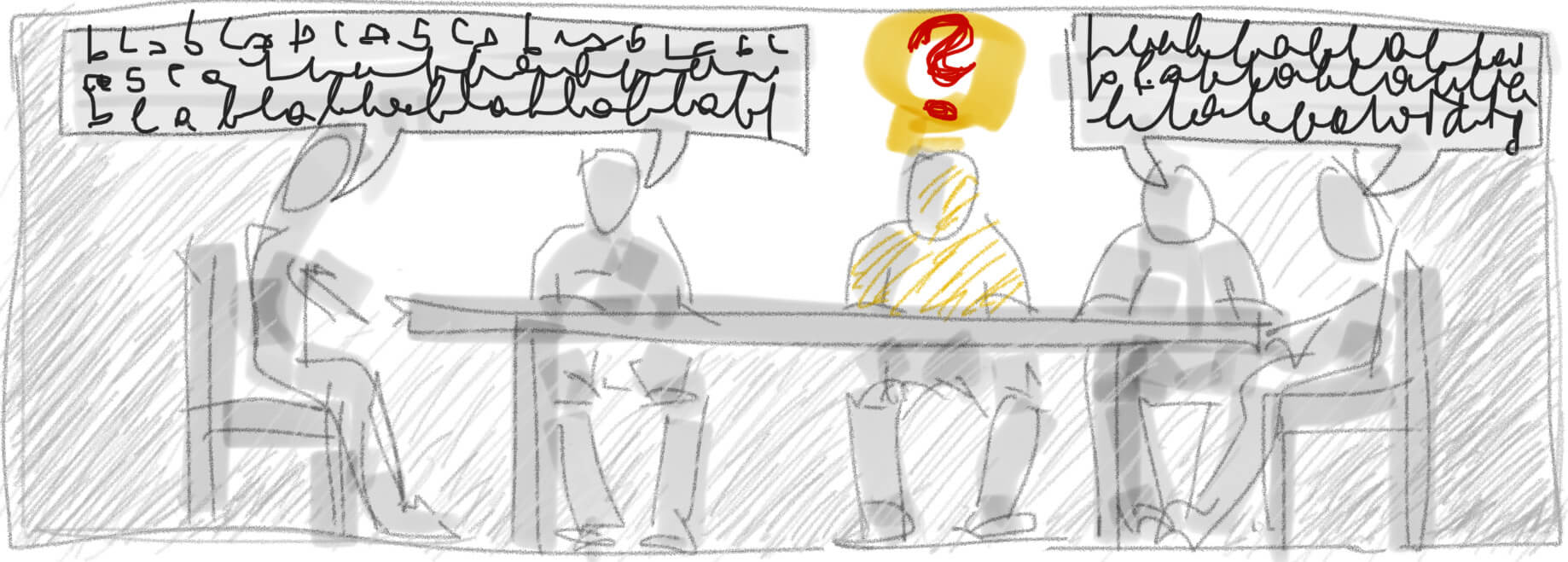
Frequent speakers and hotheads become decision-makers
Durch auf diese Weise nicht ausgesprochene Lösungsvorschläge gehen der Wirtschaft in Deutschland, Österreich und der Schweiz täglich horrende Ressourcen verloren. Die Vormachtstellung der Mitarbeiter, die sich wie “Lautsprecher” verhalten, ist für so manche fehlgeleitete Produktentwicklung und so manches Marketingdesaster verantwortlich. Autoren wie Silvia Löhken schreiben seit Jahren gegen das Ungleichgewicht zwischen “Extros” und “Intros” an. Viele Erfahrungen zeigen, dass gerade in “stillen Gewässern” oft besonders interessante Gedanken reifen. Leider geraten diese großartigen Ansichten sehr selten an die Öffentlichkeit. Wirtschaft und Gesellschaft sind aber schon zur Genüge ausgestattet mit Vielsprechern und Hitzköpfen. Was dringend gebraucht wird, sind reflektierende, abwägende Gemüter – die sich souverän zu Wort melden!
Dissatisfaction with one's own silence hinders top performance
So now a wrong decision has been made. Solcherart fehlgeleitete Entscheidungen in Unternehmen sind entwicklungstechnisch bedenklich. Noch schwerer wiegt jedoch die langsam wachsende Frustration unter jenen stets stillen Mitarbeitern, die alle Meetings mit dem Gefühl verlassen, es besser gewusst zu haben, aber nicht zu Wort gekommen zu sein. Beziehungsweise das Wort nicht ergriffen zu haben. Das trifft es nämlich besser. [bctt tweet=”Wir sind alle aufgerufen, uns zu Wort zu melden und nicht zu warten, dass wir explizit gefragt werden.” username=”ArnoFischbacher”] Das ist eine Grundvoraussetzung, die ein initiatives Teammitglied draufhaben sollte. Fast alle Mitarbeiter wissen das auch, schaffen es aber trotzdem nicht, ihre vorhandene Expertise mutig und eindeutig darzulegen.
Not speaking can cost careers
Employees who never succeed in speaking out in a larger group and giving valuable substantive input could pay a high price for their silence in the long term.
- If you are not audible, you will soon no longer be seen and at some point you will be completely overlooked in the perception of others. Also and primarily in the perception of superiors.
- If managers don't have it on their radar, they don't promote them. Despite all the existing, deep expertise. And rightly so, because if you can't or don't want to speak for yourself, you won't do so for your department or for the company.
If you are an employee i.e. you want to remain at your current workplace, and that for years to come, then you are welcome to remain silent. Otherwise, it would be high time to participate in the professional discussions with a strong voice and presence. But why do some people find it so difficult to speak up? Let's take a closer look at some of the most common reasons below.
[bctt tweet=”Nicht sprechen kann Karrieren kosten” username=”ArnoFischbacher”]I'm just a quiet nature
There are quite a few reasons for this. Some see themselves as a quieter personality and like themselves as such. That's why they don't want to change this status so much. With their calm manner, they feel authentic and completely as themselves. That gives them security. They don't want to change that. However, this is a completely misunderstood authenticity. It's not about bending over backwards and stirring up the meetings like a howler monkey, but about presenting your opinion and expertise clearly, distinctly and, of course, authentically as an adult and confident employee.
I've tried, but...
Why do so many employees fail to make themselves heard in larger discussion groups, despite all their good intentions? They want it. But, their attempts to get involved in a discussion at their own volume often fail. These quiet people believe that they themselves have to be even louder in order to drown out the others. This is not the case. Loud sounds only close the ear. The autopilot decides for the person what he wants to pay attention to. Now there is already a heated and loud discussion at a table anyway. And now there is another one who is also loud. This new voice is simply not noticed. As if she had never said anything. So the attempts of the quieter people to try their hand at volume fail miserably. Logically, they then continue to fall silent. So retributing loud with loud is not the right way either ...
Unnecessary filler words prevent attention
When people who have been quiet for a long time then start to say something, they often take refuge in the so-called orientation tone at the beginning of their statement. They then start the speech engine with a hesitant "Um, Ah or smacking Ts – these filler words never sound as if they were followed by an exciting statement worth listening to. And already the attention of the others is gone again, the following request to speak fizzles out .... But what brings the desired attention? We have a very effective repertoire of solutions at our disposal:
[bctt tweet=”Füllwörter wie >äähm< klingen nie so, als wenn danach eine hörenswerte, spannende Aussage käme.” username=”ArnoFischbacher”]- Attracting attention through the right body language: Since volume doesn't help, you have to attract the attention of your wildly discussing colleagues in other ways – e.g. through very present body language. A good way to do this is the so-called "coachman's seat". Without saying anything else, slide your chair backwards. And sit up straight without leaning against it. In a straight, tense posture, like a coachman in his high seat. And that's exactly how you are suddenly perceived. Sublime, perched higher. There will certainly be a pause now, or the voices will become quieter. And it is precisely this moment that you use to express your opinion. Try it out in the next meeting. You will be surprised!
- Leading by leading tones: The loud tone does not draw attention, but the right and powerful tone does! So lead with leading tones, and you'll get the general attention. They don't need too much or no practice to do so. It is simply a matter of making the mental decision to ask a certain question in such a way that the others in the room automatically follow this call. If you make up your mind to do this before speaking, your voice will automatically follow this impulse. In this way, a maelstrom is created that no one can escape, and the attention is yours! A "But consider .... " in this sound, makes all heads jerk up.
- Use magic words: Es gibt in der Kommunikation sehr wirksame Sesam-Öffne-Dich Wörter, die sofort aufhorchen lassen. Das sind z. B. „Wenn …. „, „Gestern …“ „So … „ oder „Wie … „. Starten Sie Ihre Sätze strategisch damit und ziehen Sie Aufmerksamkeit auf sich. Ein Klassiker und spezieller Türöffner, um gehört zu werden, ist das Wort „Angenommen ….”. Jeder wird sofort neugierig, was Sie danach als Argument folgen lassen werden!

Make a name for yourself as a wise moderator!
If you apply the above suggestions regularly in practice, you will soon be able to lead a meeting from the role of moderator with reflective questions. This allows you to wait longer, listen to others and only express yourself effectively and with impact a little later. In this way, you will distinguish yourself with your teams as a thoughtful and reliable sparring partner who never speaks too fast, but only when he really has something to say. You'll build a long-term reputation that no meeting should ever end without your statement!
From now on, sovereign in all meetings and discussions:
If you don't constantly "talk to it", but express your opinion in a reflective and relaxed way, you will be perceived in discussions and meetings as a person with a self-confident appearance, clear sovereignty and a high level of knowledge. For employees and supervisors alike. This is said to have never harmed his career!
 Yours sincerely,
Arno Fischbacher
P.S.: I'm happy if you like this post. If that's the case, please share it right away! Do you have a question or would you like to discuss my thoughts with me? Write a comment! I look forward to hearing your opinion!
Read Also:
- In a meeting: What voice do you use to make yourself heard?
- Can the voice convince even when listening?
- Perform confidently – but how?
The author:
Arno Fischbacher is a business voice coach and rhetoric expert, speaker and author. He prepares executives and employees of the top companies in Germany and Austria for negotiations, presentations and media appearances. Fischbacher is the author of several books, past president of the German Speakers Association (GSA) Austria, chairman of the European Network of Voice Experts, stimme.at.
If you would like to learn more about specific training opportunities with Arno Fischbacher, make an appointment here free information talk.
Well, since it is also a big task for me to be heard, these words are a real good position for me.
But they are forgotten exactly when they are really needed. Practice Practice Practice
thanks, lg, Rainer
Thank you, with these tips I have refreshed and supplemented my knowledge! – You can't do it often enough.
Kind regards, Paula
Thank you Arno!
like Paula before me – you can't hear or read it often enough.
… I just had an explosive conversation yesterday, with my boss, especially his reaction, could better understand through your tips. VERY VALUABLE !
THANK YOU, Arno.
Best regards! Arno
From Arno to Arno 🙂 – I'm looking forward to your feedback! Good luck for the future ... voice sells!