

By Gesine Engelage-Meyer and Sonja Hanau
Very few meetings are productive. And yet we spend a large part of our working time with them. Online meetings that have just been discontinued have exacerbated the phenomenon of "meeting marathons". Sonja Hanau, an expert in good meeting culture, explains the self-sustaining meeting cycle and suggests simple ways to finally break it.
"I don't even get to work anymore because of all the meetings." Having a lot of meetings usually means that those involved – as the saying goes – can't see the forest for the trees. Or to put it another way: because of all the appointments, you can no longer keep an eye on what is really important.
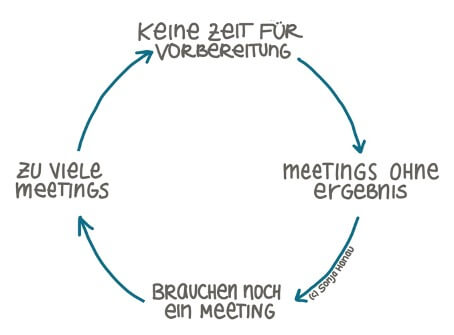
The Self-Sustaining Meeting Cycle
A paradoxical mechanism seems to be at work here. Since the many meetings take so much time, there is no time to make them productive. "Because of the many meetings, I don't have time to prepare the meetings. So let's just have another meeting."
Just having a meeting and not preparing it only saves time at first glance.
In the meeting itself, it inevitably leads to aimlessness, one-sided monologues, unnecessary detailed discussions and superfluous participation.... In other words, to all the points that give meetings their bad reputation.
⇒ How to interrupt frequent speakers elegantly and effectively, read here.
The edit cannot be completed. Not because there was too little time, but because the time was not used effectively. And what happens if a topic is not yet concluded? Then a follow-up meeting is needed.

The first step to solving the problem is to consciously address the topic and start with your own meetings. In the second step, it is then the turn of the meetings in which I am only a participant.
Two prerequisites for having fewer and better meetings at the same time
I can achieve fewer and better meetings by doing two things:
- Make it clear to myself WHAT I want to achieve.
- Thinking about HOW I can achieve it.
Knowing what I want to achieve is the basic prerequisite for reaching the goal. Seneca already said "If you don't know the port you want to sail to, no wind is the right one for you." And yet very few meetings have a clear goal. A goal that deserves its name.
⇒ Note: Four practical tips for motivating speaking in a video call
Not only clearly stating the goal of a meeting, but also thinking in advance about how it can be achieved in concrete terms is unusual for many. What specific questions should be worked on together? How does as many people as possible have their say and how can the different ideas be brought together to form a solution in a manageable time frame?
Most meetings are rather unstructured and random. One colleague talks about this topic, the other colleague picks up on one of the many facets and before it goes to the actual topic, the scheduled hour is already over again.
Moderated meetings are still far too rare in everyday meeting life, in which someone has thought in advance about how the meeting can proceed in order to achieve the set goal. Someone who takes the responsibility in the meeting to focus on this goal again and again. Even at the risk of making this role unpopular.
⇒ How to have your say effortlessly in a meeting, read here.
How can this additional responsibility be taken on when the calendar is already full?
1. A meeting with myself creates space for better meetings with others
A small but powerful option is to set up a meeting with yourself. To plan your next meeting. And to clearly define the goal and shape the path to it.

2. Courageously question each other's meetings
Now, as is well known, not all meetings are self-set. Invitations to meetings from others also regularly flutter into the mailbox. These are often meetings whose title is incomprehensible and where it is unclear why I was invited in the first place. Having the courage to demand clarity from others about what the meeting is about and why I should be there usually leads to an increase in the quality of the meetings. Because the inviter is forced by these questions to become clearer to himself what he wants to achieve. And thus takes care of a minimal preparation, which gives the next meeting more focus.
⇒ Why you sometimes unconsciously degrade people to objects when you speak, read here.
The positive effect can be increased by strictly cancelling appointments whose invitation does not indicate the goal.
3. Make time to optimize meetings
An important prerequisite for fewer and better meetings: The calendar needs space to breathe. To prepare. To let productive thoughts mature. Prioritizing your own thinking time is very effective and at the same time challenging. Companies can support their employees by introducing a collective meeting-free day.
⇒ Why online meetings fail so often – and how to do it better, read here.
4. There is no meeting one day a week
With a company-wide meeting-free day, everyone no longer has to laboriously create small spaces in their calendar on their own. They are simply there.
A meeting-free day is the chance to break the cycle of far too many meetings. And not only for the individual, but for everyone.
The new rule will make a difference
Whether all employees like the rule or not, it will make a difference. People will start talking about meetings. Think. To question routines. And that almost inevitably leads to change.
And to a change that many will quickly get used to.
It leads to fewer and simply good meetings.
The Author
Sonja Hanau does everything she can to ensure that there are fewer and better meetings. For more than ten years, the business informatics specialist has been using suitable technology and good structures to create a framework in which people can develop their potential and achieve their goals. She accompanies companies in the development of a new meeting and collaboration culture. In her lectures and workshops, she combines moderation and technical competence with lightness and humor. She lives with her family near Frankfurt.
Book recommendation
Gesine Engelage-Meyer, Sonja Hanau: Achieve more with hybrid teams. Tools, methods and practices for successful collaboration at a distance
BusinessVillage 2022. > More info




Leave A Comment