

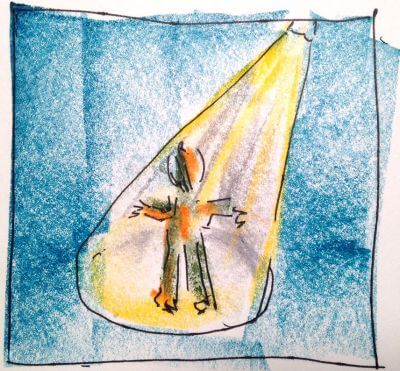
The Eurovision Song Contest usually passes me by. Since the mega event takes place in Vienna this year, I'm following the events a little more closely. Of course, I also think about the vocal preparation of performers and presenters. In particular, about the question: How do those who are in the spotlight deal with their surely galloping stage fright? How will they feel in front of this large audience in the hall? How will they react, knowing that 200 million people worldwide are watching and listening?
Certainly a situation, in which nerves are on edge. Especially the presenters are there vocally, body language and rhetorical intensively demanded. The artists have rehearsed their song often enough and "only" have to perform it. Stress enough. But the presenters have to react to the unforeseen with all their senses and still always appear confident. I am sure Mirjam Weichselbraun , Arabella Kiesbauer , Alice Tumler and Conchita Wurst , who will report from the Green Room, will do a great job – despite stage fright.
In some people trembling stage fright sets in even with very small groups that they have to face. Most people only get nervous from groups of 100 or more listeners. For some, this feverish state begins the evening before the performance, for others only on the way to the stage ...
What can these people do to appear safer, better and more effective?
From a psychological point of view, stage fright can be described as a fear of shame. On stage, embarrassing failure threatens every second: you could lose the thread, not know what to do, not remember an important word, a name, a decisive fact exactly when all eyes are on you.
Practice shows: Stage fright is most pronounced when a person's inner demand for perfection meets a need for harmony and anxious attention to the evaluation of others. These social fears often occur days before the actual event. Stage fright is taken to the extreme at the moment of the performance, when there are actually many eyes on you. This triggers old protective reflexes in the brain, which are supposed to make you physically efficient - but in our case lead to a blockage.
These paths lead to sovereignty in performance:
1. Mental preparation helps to release mental blockages.
Visualize the target image: Visualize the end of your speech! From your seat on stage, look into approving, enthusiastic faces who laugh at you and start clapping in gratitude for your speech. Feel the wave of relief rolling through you. Perceive the good feeling that you have made it.

2. Before every official appearance, a short warm-up is recommended for voice and body language. Usually 30 seconds with expansive movements, funny grimaces and childish babbling exercises are enough for the voice.
3. The performance and your first words are the key to contact with the audience:
Enter the stage elegantly, go to the center in peace and put down roots first to get into your own center.
• "Surfstand": Wait for your audience's full attention. Both feet firmly on the ground. Don't stretch your knees all the way: With the idea of standing on a surfboard or a swaying boat, loosen your knees a little, let the resulting stability flow into your voice.
• Feel self-confident security: straighten your back, while allowing the feeling of appearing "sublime". Let go of your shoulders, let your arms fall.
• Prohibition of phrases: Start by addressing the audience directly. Ask a question. Lead into a memory or imagination.
So prepared, you will experience the intensive contact with the audience as something inspiring, empowering that carries you word for word through your lecture. In this way, you can enjoy the silence and attention that your speech or moderation deserves during your speaking breaks.
A magic cure for stage fright has not yet been invented, but if you follow these tips before your next public appearance, you will find that your stage fright immediately takes on bearable proportions.
And I'm now curious about the winner of the song contest
You
Arno Fischbacher
The author:
Arno Fischbacher is a business voice coach and rhetoric expert, speaker and author. He prepares executives and employees of the top companies in Germany and Austria for negotiations, presentations and media appearances. Fischbacher is the author of several books, past president of the German Speakers Association (GSA) Austria, chairman of the European Network of Voice Experts, stimme.at.
If you would like to learn more about specific training opportunities with Arno Fischbacher, make an appointment here free information talk.


Leave A Comment