

The telephone is and remains one of the most important means of communication and thus the business card of the salesperson or the company – both to customers and business partners. Certain rules are self-evident:
1. Never take the customer's statements personally,
2. Provide a quiet environment when making phone calls, and
3. Use a headset – especially if you like to walk around, talk with your hands and feet, move around and/or take notes.
Of course, visits and acquisition meetings with customers are still important in order to maintain personal contact. But the advantages of telephone acquisition are also obvious, and not only because the financial and time expenditure is many times lower than with personal contact initiation.
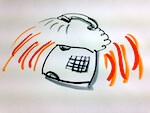 In relation to e-mail contact, the telephone is also clearly the more efficient option. In contrast to email, a phone call allows the salesperson to immediately classify the reaction of the person they are talking to in terms of the potential chances of an appointment or even their interest in the product or service. And they can still be influenced in the conversation before personal contact takes place. This is not possible with any other medium to the same extent as with the telephone.
In addition, a high degree of saturation and the corresponding defense mechanisms of many potential customers as a result of (advertising) sensory overload ensure that expensive direct mail campaigns are no longer serious competition for telephone acquisition. Nowadays, many e-mails often do not even reach the addressees.
Typical contact inhibitions and how to reduce them
If the customers fall into your portfolio and you have permission to acquire for the B2C business (always note the current legal situation (UWG, §7)), the telephone is indisputably the fastest, most efficient and most flexible instrument for customer contact and new customer acquisition. Nevertheless, many salespeople and employees with customer contact still shy away from (telephone) acquisition like the devil shies away from holy water. The reason: In contrast to the past, customers are not only more enlightened. Due to the high level of competition and the wide range of products and services in the various industries, they are also very picky, even if it is "just" to arrange a personal interview. One more reason to actively deal with possible mental cold calling blocks.
Uncertainty or fear of rejection:
A caller can be brushed off faster than a personal visitor, excuses are easier to make – or the person called simply hangs up. Before the conversation, be clear about the benefits you offer the customer and how you can make them happy. Keep reminding yourself of the many existing contacts you have made with the help of the phone and your consistent acquisition.
Lack of written documents to support the benefit argument:
Here it is important that you can compensate for apparent disadvantages when making phone calls through thorough preparation, especially by developing a conversation strategy with appropriate guidelines. Let your positive attitude towards the person you are talking to and the value of your offer have an effect, and give free rein to your creativity with regard to original "hooks".
No eye contact, no facial expressions, gestures and body language:
Voice, tone of voice and choice of words are given considerably more weight on the phone than if other sensory channels are also involved. However, don't concentrate on what you lack in terms of non-verbal possibilities when talking on the phone, but use
the opportunities offered by the targeted use of your voice and your choice of words.
Own negative mood:
Free yourself from self-fulfilling prophecies – as is well known, according to Murphy's Law, exactly what you are imagining goes wrong. Even thorough preparation for the acquisition interview will help you to overcome the failure self-programming à la "He's not interested anyway". Activate your positive self-image as a successful salesperson, and if, contrary to expectations, you are not successful, realize that every rejection is a signpost to the next prospect.
Fear of calling at an inconvenient time
Many salespeople then fear a correspondingly rough reaction from the customer. In any case, it conveys uncertainty if you ask if you are disturbing or if the customer has time. Instead, assume that a customer who answers your call is curious – use this curiosity to start the conversation with a clever hook. With a friendly greeting and a direct start to the conversation, you convey the self-confidence of having a concern that is definitely worth hearing.
About Martin Limbeck
 Martin Limbeck is one of the most sought-after sales experts in the English- and German-speaking world. For over 20 years, he has been inspiring employees from management and sales with his insider know-how and practical strategies. To date, he has performed in more than 20 countries around the world. Not only in his provocative and motivating lectures, but also in the implementation-oriented trainings, the focus is on progressive selling in its entirety. This has made him one of the most effective and effective speakers in recent years and the coach of the years 2008 and 2011.
More information at www.martinlimbeck.de .
Event tip
 THE NEW HARDSELLING® Selling means selling
The 3-day power seminar 2014 from April 7 – 9 at the Kameha Grand Hotel in Bonn with Martin Limbeck and Rolf Bielinski in their seminar in Bonn: More appointments, faster deals, higher margins, more additional sales: A lot of knowledge and practical implementation in live phone calls.
Recommended reading
 "He hasn't bought yet – that's what top salespeople think"
Redline Verlag, new edition 2013
ISBN 978-3-86881-490-3
208 pages, € 19,99
Leave A Comment